

In the process of foreign trade website SEO optimization, many companies spend a lot of time researching keywords, yet overlook a more important issue—keyword layout.
In fact, no matter how precisely keywords are selected, if the placement is unreasonable, it is difficult to achieve ideal search rankings.
So, what is keyword placement? Why is it so important for SEO? And how should keywords be properly placed?
What is keyword placement?
Keyword placement refers to the reasonable distribution of target keywords across different pages and content positions of a website, helping search engines understand the page topic and improving the website's ranking in relevant search results.
Simply put, keyword placement is not just about inserting keywords into articles, but arranging different types of keywords in the most suitable positions based on the website structure and content planning.
For example:
Homepage places core industry keywords
Product pages place product keywords
Category pages place industry category keywords
Blog pages place long-tail keywords
Through reasonable placement, search engines can more accurately determine the topic and value of each page.
Why is keyword placement so important?
Helps search engines understand page content
Google determines the page topic through keywords on the page.
If keywords appear in the title, body text, URL, and image descriptions, search engines can quickly identify the content discussed on the page.
For example:
Page title:
Custom Aluminum Bottle Caps Manufacturer
URL:
/custom-aluminum-bottle-caps/
Body text:
Introduce product features, application scenarios, and customization services.
This way, Google can clearly know that the page is related to “Aluminum Bottle Caps”.
Increases keyword ranking opportunities
Reasonable keyword placement can increase the relevance of the page to the target search terms.
When users search for related content, Google is more likely to display your page in the search results.
Avoids keyword competition between pages
Many corporate websites have a common problem:
Multiple pages optimize the same keyword.
This situation is called “Keyword Cannibalization”.
For example:
Homepage optimizes Packaging Manufacturer
Product page also optimizes Packaging Manufacturer
Blog page also optimizes Packaging Manufacturer
As a result, Google cannot determine which page is more important, affecting overall rankings.
Reasonable placement can avoid this problem.
How should website keywords be placed?
Homepage places core keywords
The homepage usually has the highest weight, so it is recommended to place core industry keywords.
For example:
Packaging Manufacturer
Custom Headwear Manufacturer
Outdoor Furniture Supplier
Aluminum Caps Manufacturer
Core keywords are highly competitive, so they are more suitable for long-term optimization on the homepage.
Product pages place product keywords
Product pages should focus on optimizing specific product keywords.
For example:
Aluminum Wine Caps
BBQ Grill Tools
Custom Baseball Caps
Stainless Steel Water Bottles
Each product page should focus on one main keyword.
Category pages place industry keywords
If the website has many products, category pages can be used to place industry-related keywords.
For example:
BBQ Accessories
Outdoor Furniture
Cosmetic Bags
Packaging Solutions
Category pages can capture a large amount of related search traffic.
Blog pages place long-tail keywords
Blogs are an important channel for obtaining search traffic.
It is recommended to write content around common customer questions.
For example:
How to Choose Aluminum Bottle Caps
What Is OEM Manufacturing
Benefits of Custom Packaging
How Long Does Google Take to Index a New Website
Long-tail keywords have lower competition and are easier to rank.
Where should keywords appear?
Page title (Title)
The page title is one of the most important SEO elements.
For example:
Custom Aluminum Bottle Caps Manufacturer | Company Name
2.URL Link
The URL should be concise and include the target keyword.
For example:
Correct:
/custom-aluminum-bottle-caps/
Incorrect:
/product-12345/
Click to view how to optimize URL
H1 heading
Each page should include an H1 heading that incorporates the core keyword.
For example:
Custom Aluminum Bottle Caps Manufacturer
H2 and H3 subheadings
Appropriately include related keywords in subheadings.
For example:
Features of Aluminum Bottle Caps
Custom Design Options
Quality Control Process
Body text
Keywords should naturally appear in the article content.
Do not deliberately stuff keywords for SEO
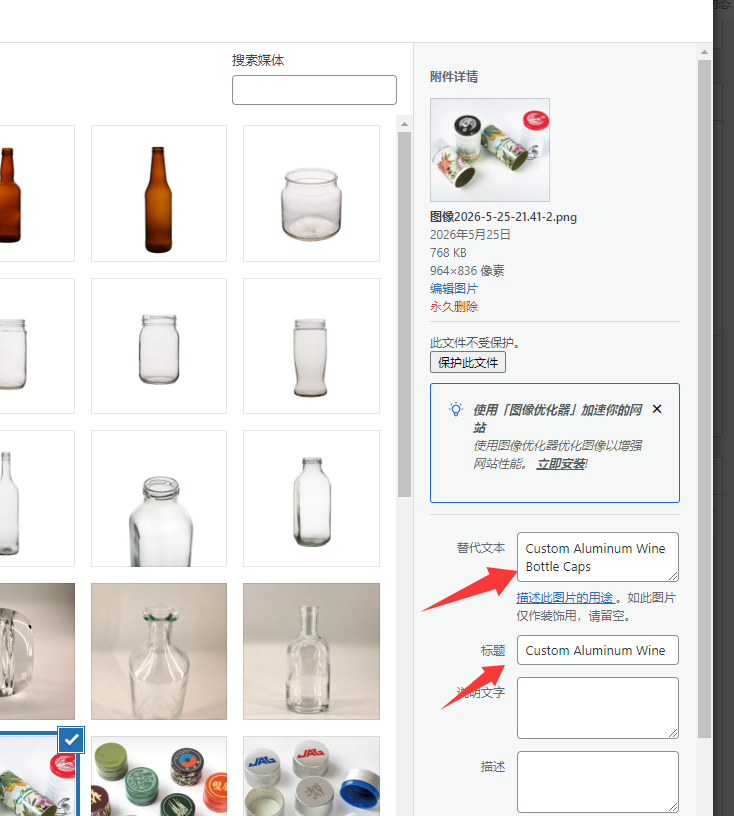
6.Image ALT Tag
Search engines cannot directly recognize image content, so ALT tags are needed to describe the image.
For example:
alt=”Custom Aluminum Wine Bottle Caps”
Common mistakes in keyword placement
Keyword stuffing
Incorrect example:
“Our company is a packaging manufacturer. As a packaging manufacturer, we provide packaging manufacturer services...”
Such content not only affects user experience but may also be penalized by search engines.
Optimizing multiple core keywords on one page
For example, simultaneously optimizing:
Packaging Manufacturer
Bottle Cap Manufacturer
Cosmetic Bag Manufacturer
This leads to an unclear page topic.
It is recommended to focus on one core keyword per page.
Ignoring long-tail keywords
Many companies only focus on high-competition keywords, ignoring a large amount of precise traffic sources.
In fact, long-tail keywords often bring higher inquiry conversion rates.
Best strategy for keyword placement
A mature website usually adopts a keyword pyramid structure:
First layer: Homepage core keywords
Second layer: Category page industry keywords
Third layer: Product page product keywords
Fourth layer: Blog page long-tail keywords
Such a layout not only benefits SEO rankings but also forms a clear website structure.