

A clear, concise, and descriptive URL not only helps search engines better understand page content but also enhances user experience, increasing page click-through rates and sharing rates.
So, what kind of URL is considered SEO-friendly? And how should you optimize your website's URLs? This article will provide a detailed introduction.
What is a website URL?
URL (Uniform Resource Locator) is the web address.
For example:https://example.com/website-seo-guide/
Among them:
- https:// 为协议
- example.com is the domain name
- /website-seo-guide/ is the page path
Search engines use the URL to understand the page topic, while users also judge whether the page content matches their needs based on the URL.
Therefore, a reasonable URL structure is significant for SEO.
Why is URL optimization important for SEO?
Although URL is not the only factor affecting rankings, it plays an important role for both search engines and users.
Helps search engines understand page content
Google uses keywords in the URL to determine the page topic.
For example:https://example.com/image-seo-guide/
Compared to:https://example.com/post-123/
Search engines can obviously more easily understand that the former's content is related to image SEO.
Improves user click-through rate
When users see a concise and clear URL in search results, they are more likely to click.
For example: example.com/wordpress-seo-tips
Compared to example.com/category/post?id=587
So when users see these two URLs, which link do you think they would be more willing to click?
Things to note for website URL optimization
Keep URLs as short as possible
The shorter the URL, the easier it is for search engines and users to understand.
Do not include dates, categories, and redundant descriptions in URLs, as this will make URLs lengthy and complex.
For example:
Not recommended:https://example.com/2025/06/website-seo-ranking-guide-for-beginners/
Recommended:https://example.com/website-seo-guide/
On the premise of ensuring keyword completeness, minimize meaningless content. In Google Search Console, there are relevant rules and introductions for URL structure:
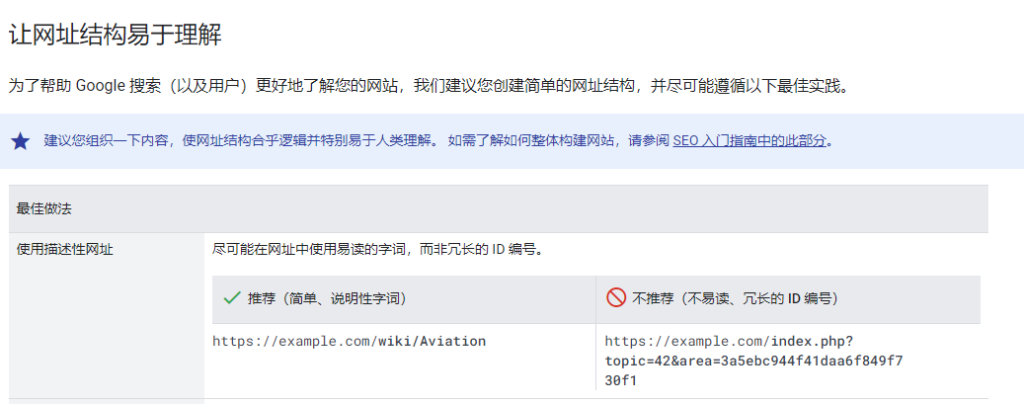
Include core keywords in the URL
Keywords help search engines quickly identify the page topic.
For example:
Article topic is image optimization:
Recommended:
/image-optimization/
Instead of:
/article-001/
Keywords in the URL should be consistent with the page title and content, but avoid keyword stuffing.Usually, the number of added keywords should be controlled to 2~4; overly long ones are not recommended
Incorrect example:
/seo-seo-seo-website-seo-google-seo/
Correct example:
/website-seo-guide/
Use English URLs instead of Chinese URLs
Many content management systems support generating Chinese URLs directly, but in practice, they are automatically converted to encoded characters.
For example:
Chinese URL:
/how-to-optimize-website-url/
May display as:
/%e5%a6%82%e4%bd%95%e4%bc%98%e5%8c%96%e7%bd%91%e7%ab%99url/
Such URLs are not only unfavorable for sharing but also inconvenient for management and analysis.
It is recommended to use corresponding English keywords:
/website-url-optimization/
More concise and professional.
Use hyphens (-) to separate words
Google officially recommends using hyphens as word separators.
Recommended:
/wordpress-seo-guide/
Not recommended:
/wordpress_seo_guide/
/wordpressseoguide/
Hyphens help search engines accurately identify multiple words, improving URL readability.
Keep URLs stable long-term
Once a URL is indexed by search engines, try not to modify it frequently.
Frequent URL changes may lead to:
- Loss of page authority
- Ranking drops
- 404 errors
- User access failures
If a URL must be modified, be sure to set up a 301 redirect to permanently redirect the old link to the new one.
This can maximize the preservation of SEO authority.
Common mistakes in URL optimization
In actual website operations, the following issues are often encountered:
Using dynamic parameters
For example:
/product?id=12345
Although search engines can recognize it, users cannot understand the page content.
Recommended:
/stainless-steel-door/
URL hierarchy too deep
For example:
/category/product/industry/market/news/article-title/
Deep hierarchies increase the difficulty for search engines to crawl.
It is recommended to keep it within 2-3 levels.
Extensive use of meaningless characters
For example:
/page-001/
/post-888/
/article-456/
These characters do not reflect the page topic and are not helpful for SEO.
URL optimization suggestions for foreign trade websites
For foreign trade standalone websites, URL optimization is particularly important.
It is recommended to follow these principles:
- Use English keywords
- Keep it concise and readable
- Avoid dates and numbers
- Use hyphens to separate words
- Keep consistent with the page topic
- Do not frequently modify the URL structure
Although URL is just a small detail on a website, it directly affects search engine crawling, keyword rankings, and user experience.
An excellent SEO-friendly URL typically has the following characteristics:
- Short and clear
- Contains core keywords
- Uses English words
- Uses hyphens for separation
- Reasonable structural hierarchy
- Remains stable long-term
Planning the URL structure early in the website building process can lay a solid foundation for subsequent SEO optimization and avoid risks from large-scale modifications later.
If you are building a corporate website, foreign trade standalone site, or WordPress site, it is recommended to include URL optimization as an important part of your SEO plan, starting from the details to improve overall website performance.