

For B2B foreign trade enterprises, keyword research is an important foundation for website SEO optimization. Website content is created based on keywords, making the website's content themes more aligned with the needs of target customers, thereby improving optimization results.
Effective keyword research is not just about collecting search terms and query search volumes, but about figuring out what overseas customers will search for, what they hope to find, and which page of the website should satisfy these needs.
This article will introduce keyword research methods suitable for manufacturing and B2B foreign trade enterprises from several aspects: target customer analysis, seed keyword mining, keyword screening, page layout, and follow-up optimization.
Step 1: First clarify target customers and keyword research direction
Before starting keyword research, first clarify the company's main products, target market, and ideal customers. Only by understanding our target users' needs can we create more valuable website content. Therefore, when doing keyword research and analysis, it is also a process of understanding user needs.
What products or services does the company mainly sell?
Try to be as specific as possible about product categories, models, materials, processing methods, and application scenarios.
For example, machinery manufacturing enterprises can be further subdivided into CNC precision machined parts, custom metal components, mining wear parts, or agricultural machinery parts, rather than only using broad terms such as Machinery or Metal Parts.
2.Which customers does the company hope to attract?
Different customers do not have the same search habits. Equipment manufacturers may focus on component specifications and supporting capabilities, importers may focus on suppliers, bulk procurement, and delivery capabilities, while engineers may care more about material performance, technical parameters, and machining accuracy.
At which stage of the procurement process is the customer?
Search needs can be roughly divided into three categories:
| Search intent | Keyword examples | Pages suitable for layout |
|---|---|---|
| Information gathering | how to choose CNC machining materials | Technical blogs, procurement guides |
| Product comparison | forged parts vs cast parts | Technical articles, solution pages |
| Finding suppliers | custom CNC machining manufacturer | Product pages, machining service pages |
After clarifying this information, formulating a keyword plan can reduce ineffective traffic and make keyword layout closer to the enterprise's customer acquisition goals.
Step 2: Seed keyword mining (5 free channels)
Extract from customer inquiries and sales records
The words actually used by customers often have more reference value than the product names used internally by the enterprise.
You can organize customer emails, inquiry forms, quotation records, exhibition communication content, and questions frequently answered by sales staff, focusing on extracting product names, material requirements, usage scenarios, customization needs, and procurement conditions.
For example, the enterprise may use a name such as “non-standard precision parts” internally, but overseas customers may more often use custom precision machined parts or specific part names.
Do not directly assume which English term is more popular among overseas customers. Instead, use these terms as candidate keywords and then verify them through search results and keyword tools.
Analyze competitors' websites
Select several peers with similar product positioning, target markets, and customer groups, and focus on reviewing the following:
- Homepage title and core business positioning.
- Names and page themes of product category pages.
- Specifications, materials, and application vocabulary used on product detail pages.
- Customer needs covered by technical articles and FAQs.
- How pages are linked to each other through internal links.
Competitors' websites can help discover missed keyword directions, but do not directly copy their page titles and content. It is necessary to judge whether their keywords match your own product and service capabilities.
Use Google Autocomplete and related searches
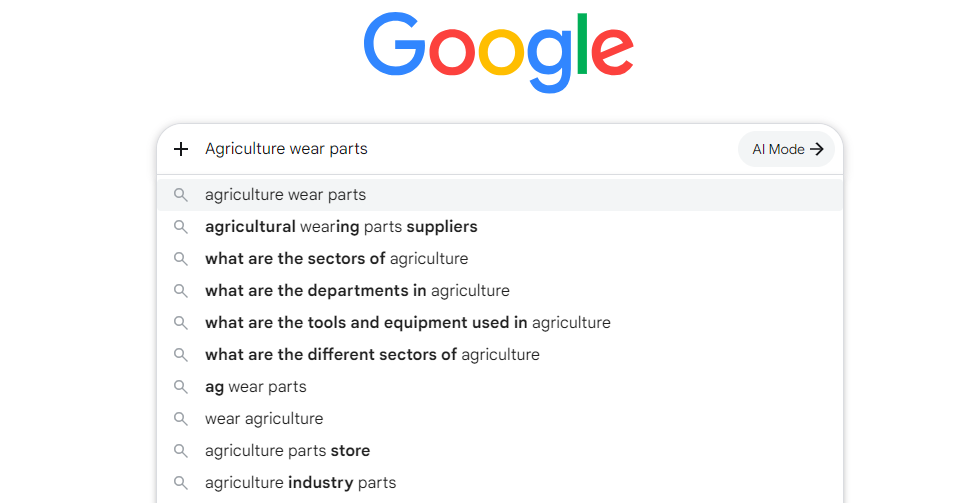
Enter product terms in the Google search box, observe autocomplete suggestions, and then check the related searches at the bottom of the search results page.
For example, enter Agriculture wear parts, and you can expand keywords from six directions: product names, applicable equipment, part types, material processes, procurement needs, and application scenarios
These suggestions can help discover expressions commonly used by users, but they do not mean that all suggested terms have high search volume or clear commercial value. Further screening is still needed.
Check overseas industry forums and professional communities
LinkedIn industry discussions, professional forums, YouTube comments, and related communities can help enterprises understand the problems overseas buyers encounter in actual work.
For example, customers may care about whether a certain material is suitable for high-wear environments, the cost differences between different processing techniques, or how to determine whether parts meet equipment requirements.
These questions are not necessarily all suitable as product keywords, but they can become topic sources for technical blogs, application guides, and FAQs.
Research product categories and titles on B2B platforms
For manufacturing export enterprises, you can check product categories, procurement needs, and product titles on Alibaba.com and other related B2B platforms.
Focus on how customers describe products, which specifications frequently appear, and how suppliers express customization and application capabilities.
The vocabulary on the platforms is suitable for expanding candidate terms, but not all words in product titles can be directly regarded as valid Google SEO keywords.
Step 3: Use keyword tools to validate and expand candidate terms
After completing the initial collection, you can use keyword tools to understand search demand, competition, and related terms.
SERPROBOT : You can view keyword ranking data for multiple countries and regions, and view rankings for 5 keywords at a time (free). Login method:https://www.serprobot.com/serp-check
Small SEO Tools- Keyword Position : This function takes a long time to query, the analysis content is relatively comprehensive, and it is mainly free, so it is recommended. Login method:https://smallseotools.com/keyword-position/
SEMRUSH: You can analyze search volume and keyword ranking data for various countries, as well as traffic estimates, etc. (paid). Login method:https://www.semrush.com/
The data provided by the tools is one of the bases for judgment, but the final selection of keywords still needs to be combined with actual Google search results, customer needs, and the company's business capabilities.
Step 4: Build a master keyword layout table for the website
After collecting candidate keywords, it is not recommended to directly assign all keywords to website pages. First build a keyword table, recording each keyword's search intent, product relevance, competition situation, and target page.
Through keywords:
- Lay out high-search-volume, low-competition-difficulty keywords to quickly improve website exposure and traffic
- Through keyword grouping and expansion, capture segmented traffic and precise customers for the website
- Use keywords as content material to clarify writing themes and content, avoiding deviation from the page topic
- Plan the optimization strategy well in advance, clarify the optimization direction, and reasonably allocate time and budget.
Step 5: Assign keywords to appropriate website pages
The ultimate purpose of keyword research is to ensure that every important page on the website has a clear topic and goal.
If multiple pages target the same core keyword at the same time without clear content differences, problems such as overlapping page topics, internal competition, or users not knowing which page to visit may arise.
It is recommended to assign them in the following way:
Homepage: Highlight the company's core business
The homepage should focus on introducing the company's main products, service scope, and target market, and lay out a small number of core commercial keywords that best represent the company's business.
Do not pile all product keywords onto the homepage. Instead, guide visitors to the corresponding product pages through clear category navigation.
Product category pages: Cover product category keywords
Product category pages are suitable for targeting keywords with clear product category intent.
Product detail pages: Cover specific products and specification requirements
Product detail pages should focus on displaying specific product names, models, materials, sizes, performance, application scenarios, and customization options.
If customers usually look for parts by model, material, or usage scenario, relevant information can be naturally presented in the page title, product introduction, and technical parameters.
Each page should provide enough independent information, rather than generating a large number of pages with similar content by only replacing product names.
Service or solution pages: Cover processing capabilities and application requirements
If the company provides processing from drawings, OEM/ODM, custom manufacturing, or specific process services, independent pages can be established based on actual business.
Such pages are suitable for explaining processing capabilities, applicable materials, production processes, quality control, and cooperation methods, helping buyers who are screening suppliers judge whether the company meets their needs.
Blog articles: Cover informational and problem-based keywords
Blogs are suitable for answering questions that buyers encounter when researching products and screening suppliers, such as material selection, processing technique comparisons, product maintenance, and purchasing precautions.
Articles should link to relevant product category pages, product detail pages, or service pages in appropriate places, so that readers can further understand specific products.
If you are still unclear about how to assign keywords to pages, you can refer toForeign trade website keyword layout methodsto further plan the keyword division of the homepage, product pages, service pages, and blog.
Step 6: Build clear keyword topic relationships through internal links
Internal links not only help visitors continue browsing related content, but also help search engines discover relationships between pages.
When adding internal links, it is recommended to pay attention to the following points:
Anchor text should describe the target page, for example, the following figure shows an internal link in the Yijian page. The anchor text link can tell users and Google that the topic of the page I am linking to is about “Foreign trade website keyword layout methods”

- Links should be relevant to the context. Do not force links into irrelevant paragraphs just to insert keywords.
- Prioritize linking to important pages. Product category pages, core product pages, and key service pages should receive reasonable internal link support.
- Avoid repeatedly stuffing keywords. The same page does not need to repeatedly use exactly the same keywords as link text.
- Ensure that links can be accessed normally. Do not link to irrelevant pages, broken pages, or addresses that have not yet been published.
Summary of how to do keyword research
Keyword research for foreign trade B2B websites is not simply about finding English words with high search volume, but about understanding the needs of overseas buyers and allocating these needs to appropriate website pages.
Enterprises can start from their main products and target customers, dig out candidate words through customer records, competitors, Google search suggestions, and keyword tools, and then determine priorities based on relevance, search intent, commercial value, and competition.
Next, reasonably allocate keywords to the homepage, product category pages, product detail pages, service pages, and blog, and establish a clear website structure through relevant internal links.
If you want these keywords to ultimately convert into effective overseas inquiries, you also need to ensure that website pages can clearly display products, technical capabilities, quality control, and contact channels.
Keyword research is the starting point of SEO. Only by combining keyword planning, page content, website structure, and subsequent data analysis can a natural search traffic channel that better aligns with the company's business goals be gradually established.